

Lifelong environmentalist Libby Rouan discovered her passion—and herself—at UC Santa Cruz.
“The natural environment did me wonders, it fed my soul,” Rouan said. “I am still living and learning by the principles my UCSC professors taught me.”
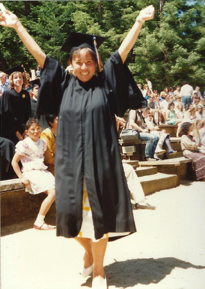
Libby Rouan celebrates her graduation from UC Santa Cruz. (Photo courtesy Libby Rouan)
Rouan (Crown ’89, biology and environmental studies) says attending UC Santa Cruz was among the best decisions she has made in life. In particular, the Natural History Field Quarter helped shape her personal and professional paths. Field quarter participants camp at UC Natural Reserves; learn about California natural history and land management; and gain valuable career skills in field ecology, education, science illustration, writing, and environmental policy and management.
“You can’t get that kind of experience any other way,” Rouan says. “Conditions are harsh; there are long, cold days; long, hot days. It’s messy, but you learn things about yourself and you learn what it’s like in the real world. It changed me.”
The program’s observation study was especially impactful for Rouan. During observation study, students are encouraged to spend time alone, choose an item to explore—perhaps a flower, an insect, or a species—and observe it for three hours.
At first, Rouan says, three hours seemed like an interminable amount of time. After the first hour, she felt she’d learned all she needed to know about the poppy bush she was observing. But then she began to explore deeper. She picked off a leaf. She scraped some of the stem. She dug around its roots. And, she says, she learned things about the poppy that she never would have known if she hadn’t taken the time.
It’s an approach Rouan has used throughout her 34-year career with San Mateo County Environmental Health Services.
“There are times when I need to sit with a problem I’m working on, to look at it from different angles, to dig deeper,” she says. “The observation study taught me a new way of approaching an issue. Sometimes, you have to take a big step back, let some time go by, and then go in again—and then you can see things more clearly.”
Rouan has spent her career fighting for the environment, helping people and communities dispose of hazardous chemicals responsibly. She works to influence policy, educate the public, and help make people aware of how their decisions make a difference.
She was in her first year at UC Santa Cruz when the 1984 Union Carbide chemical accident, arguably the world’s worst environmental disaster, occurred in Bhopal, India.
“I knew then that my focus was going to be on protecting the environment, being an environmentalist, and dealing with these chemicals,” she says. “It [a disaster of that magnitude] was not going to happen again. Not on my watch.”
Rouan expanded her major in biology to include environmental studies. She signed up for field quarter to fully understand how ecosystems work and gain hands-on knowledge about plant physiology and field methods to complement what she was learning in the classroom.
She also learned an important term from field quarter founder Ken Norris: “Be on the right side of the ledger.”
“Even though it’s an accounting term, I understood it from the environmental perspective,” Rouan said. “Whether it’s water rights versus the salmon-fishing industry versus Indigenous people’s rights. Make sure you’re on the side of the ledger that 100 percent is right for you. And for my whole career, that’s where I’ve worked to be.”
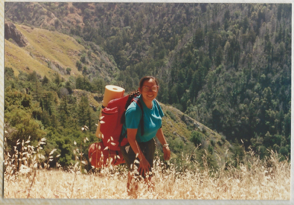
Field quarter had a lifelong impact on alumna Libby Rouan. (Photo courtesy Libby Rouan)
Rouan is grateful for the Natural History Field Quarter and the lessons it taught her. So much so that she has included field quarter in her will. Ultimately, her gift will allow future students to participate in the program that made a difference in her life.
“Philanthropy is about giving back to the causes that you care about, creating opportunities that wouldn’t necessarily be there otherwise,” she says. “It all starts with my dad. He was a public school teacher and he was very passionate about education. That has stuck with me, and I hope my gift helps a student who wants to experience field quarter.
“I just want to help anyone who wants to gain from that experience,” she says. “I want to give them the opportunity I had.”
For information about making your own planned charitable gift to UC Santa Cruz, visit the Gift Planning website.